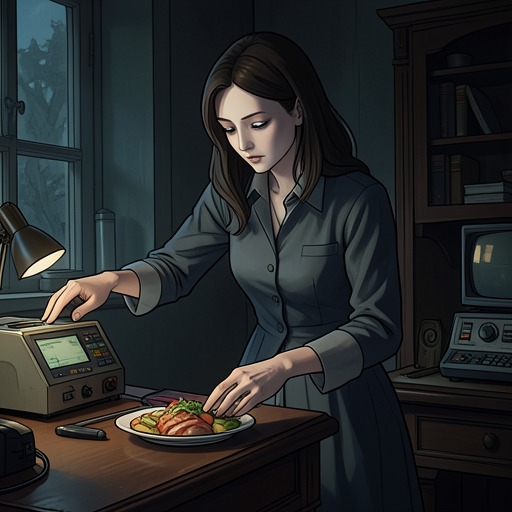
Accept your own nature
Bones & AllAccept your own nature is the rule Sully offers Maren for living with the condition that makes them eaters. His counsel turns an involuntary hunger into something to be acknowledged rather than denied, but Francis Yearly’s account reveals the limit of that simple prescription: recognizing what one is does not settle how to live with it, or how to protect others from its possible consequences.
Sully’s First Rule
Sully states the principle directly: “Can’t help what you are, Missy. That’s rule number one.” He speaks after explaining that he eats people who are already dead. He says he can sometimes sense when someone is close to death, though he cannot describe the perception as a particular smell or look. In the past, waiting outside a person’s house made him feel like a vulture; now, he says, he no longer thinks of it that way. His rule reframes the appetite and the shame attached to it as facts of his nature, not conditions that can be wished away.
The advice arrives amid ordinary, physical gestures that make the subject difficult to abstract. Sully drops his braided hair rope into his lap, takes an apple from Mrs. Harmon’s fruit bowl, and peels it with an army knife from his red flannel shirt. He offers Maren a slice on the knife. She is still disturbed by the thought of Mrs. Harmon on his hands and by the hair of the dead people he has carried, but accepts the apple rather than offend him. The scene holds repulsion and courtesy together: accepting a fact about oneself does not make it easy for someone else to encounter.
Hunger, Death, and Inherited Wisdom
Sully gives Maren a further account of why eating the dead might be understood differently from ordinary predation. He describes South Pacific island communities in which eating the dead is sacred and communal. In his example, descendants consume parts of their ancestors and inherit what those ancestors learned through life. Maren questions the logic: why should a person’s children need to eat them to learn what they know? Sully answers, “Wisdom can’t be taught, girl.” His story makes consumption a form of continuity between generations, while Maren’s objection exposes the gap between that explanation and the act itself.
The comparison does not erase the unsettling nature of Sully’s practice. Instead, it places the rule against a broader question about what counts as nourishment and what meanings people attach to eating flesh. The author’s acknowledgments explicitly connect the novel to a desire to examine flesh eating and its environmental and spiritual consequences. Sully’s defense of accepting what one is therefore sits within a story that asks readers to look again at practices more familiar than his, rather than treating the eater’s taboo as an isolated curiosity.
Francis Yearly’s Different Reckoning
Francis Yearly’s account gives the rule a more painful counterpoint. Writing to Maren, he remembers being a very small child beside a bus at a gas station. A man led him into a restroom and tried to make him do something bad; Francis recalls, “I ate him.” He distinguishes his condition from ordinary people eating steak or hamburgers: even with his milk teeth, he ground the man’s bones down, and eating made him hungrier. His memory presents the condition not as a chosen identity or a cultivated custom but as something that emerged in childhood under threat and then proved impossible to contain through ordinary categories.
Francis says that Maren’s mother, Janelle, made him feel he could live honestly and be good even after learning what he had done. He loved her in part because she could make him forget that he was a monster. Yet he also explains why he left: he believed he would never hurt Janelle or Maren, but could never be completely sure. Where Sully’s rule urges recognition without self-reproach, Francis’s account joins recognition to fear and responsibility. He does not claim that his nature makes every action inevitable; he leaves because uncertainty about the danger matters to him more than the life he wanted to share with his family.
What the Rule Can and Cannot Resolve
The rule offers relief from denial and from the futile expectation that a person can simply become something else. Sully’s change in how he thinks about waiting for the dying shows how acknowledgment can alter his relation to his own behavior: the hunger remains, but he no longer describes himself as a vulture. His story of sacred ancestral eating also gives the eater an alternative to isolation, imagining consumption as part of a community’s continuity.
Francis’s letter prevents that acceptance from becoming a complete moral answer. He accepts the truth of his condition, yet the possibility of harm remains part of his judgment about what to do. Across their different accounts, the principle means facing the self without disguise; it does not promise that facing oneself will remove shame, settle the ethics of an act, or make intimacy safe. The tension between those claims gives Sully’s rule its force—and its limits.